The Corner That Turns a Route into a Place
A street corner can feel like a pause rather than a turn. Learn how frontage, sightlines and path junctions shape recognition and everyday use.
You leave the bakery with a warm paper bag, turn past a blank wall and realise you have walked beyond the place where you meant to stop. The corner was easy to pass through, but hard to recognise as a destination. A street corner becomes a place when its frontage, sightlines and meeting paths give people a reason to notice it and a clear way to pause.
That does not require a grand building or a formal square. Often, the difference lies in small, readable cues: a door facing the pavement, a window that reveals activity, a tree at the bend, or a path that meets the street without making people guess where to go. When those cues fail, the corner can feel confusing, exposed or simply forgettable.
Why does a familiar corner still feel like a turning point?
A corner may be physically prominent without being socially legible. A sharp kerb, a wide carriageway or a tall façade announces a change in direction, but does not necessarily tell someone that it is a sensible place to wait, meet or linger.
Look at what faces the pavement at eye level. A long run of shutters, a service door or a blank side wall gives little indication of what happens here. Even a shopfront may contribute little if its entrance sits around the bend and its windows are obscured by displays or reflections.
What to try: identify the first point from which someone approaching can recognise the corner, then note what they can see there. If the answer is only “the road turns”, consider whether an existing window, doorway, sign or distinctive material could help make the place recognisable without adding visual clutter.
What makes a frontage feel like it belongs to the corner?
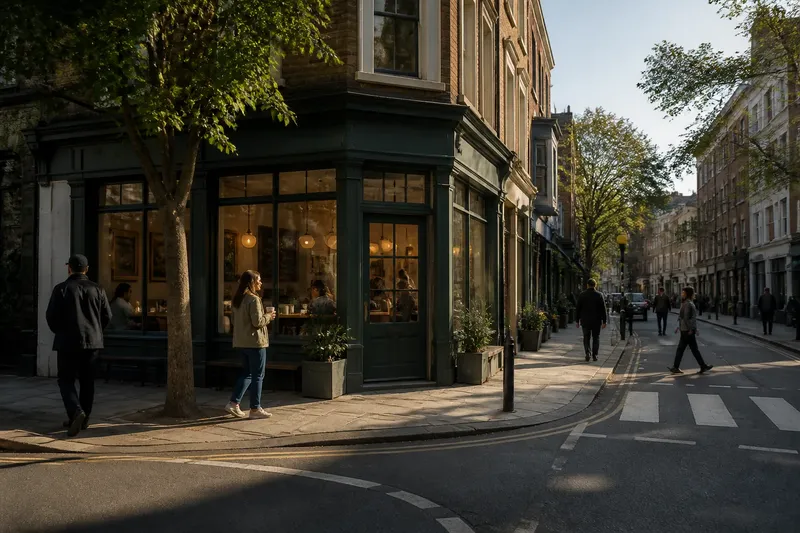
Frontage is not simply the wall along the street; it is the part of a building that meets everyday movement. A door set beside the bend, a café window wrapping around the façade, or a shallow display facing both directions can make the corner read as a threshold rather than a leftover edge.
Problems arise when the most active part of a building is hidden on the quieter side, while the corner itself is given to blank cladding or a loading entrance. This may be the result of internal layouts, servicing needs or the shape of the plot. The visible effect is that people receive no invitation to look, enter or pause at the turn.
What to try: work with the frontage that already exists. A corner-facing window can be kept visually clear; a shop sign can be positioned so it is legible from both approaches; a building manager may be able to use a recessed doorway or a lit display to mark the bend. Where a wall must remain closed, a carefully placed street name or building marker can still help people orient themselves.
How can a corner be seen before someone reaches it?
Visibility is about more than having an unobstructed view. People need enough advance notice to understand what is ahead and enough detail to distinguish the corner from the stretch of street behind it. A tree canopy, a projecting upper floor or a sign placed too close to the bend can conceal the useful cues until the last moment.
At other corners, the view is so open that people feel exposed. A broad paved area with no edge, seating or active window may be easy to see across but difficult to occupy. The space offers little sense of where a person can stand without blocking others or feeling on display.
What to try: inspect the corner from each approach at ordinary walking pace, not just from a map or a stationary viewpoint. Notice what appears first, what becomes visible around the bend, and whether a person waiting can stand beside the main flow. If a sign, planter or temporary display blocks a key view, repositioning it may help; any permanent change to street furniture or sightlines should be considered alongside local access and safety requirements.
Why do paths meet without making a clear place to stop?
Where two streets, a footpath and a crossing, or a building entrance and pavement meet, people need to understand which direction belongs to them. If foot traffic converges at a narrow kerb or spills across a doorway, the corner becomes a pinch point. People may hesitate because they are unsure where others are heading, not because they lack a place to go.
A different problem occurs when paths simply brush past one another. A cut-through may be useful as a route but offer no point where someone can step aside, look around or wait for a companion. The route is present; a pause has not been made possible.
What to try: observe the lines people already take. If they consistently walk around a planter or bunch near a crossing, that pattern may reveal a conflict between the intended route and the space available. A modest shift in movable furniture, a clearer pavement edge or a more visible crossing approach can help, provided it does not obstruct access or create a new squeeze point.
What should you check when a corner feels awkward?
A useful diagnosis begins with the particular difficulty, rather than a wish to make the corner “more welcoming” in the abstract. Is it hard to find, uncomfortable to wait at, or unclear where paths lead? Each calls for a different response, and a change that helps one issue can make another worse.
- Approach: Can someone recognise the corner before arriving? If not, look for a clear marker or a frontage detail visible from further along the street.
- Frontage: Is there an active door or window facing the turn? If the wall is blank, consider whether an existing use can address the street more directly.
- Sightline: Can people see the crossing, path or entrance they need? If not, review signs, displays and planting that obscure it.
- Waiting space: Can someone pause without standing in the main stream of movement? If not, identify a suitable edge before adding seating or other objects.
- Path meeting: Do walking lines cross awkwardly or force a detour? If so, clarify the route rather than narrowing it with decorative features.
- Recognition: Is there a detail people can use to describe the place to one another? If not, a distinctive sign, window or material may provide a simple reference point.
Say a neighbourhood association notices that people waiting for friends gather directly outside a narrow shop entrance. The association could first observe the corner at different ordinary periods, then ask the shopkeeper whether a nearby wall-facing window or an existing recessed edge could serve as a clearer meeting point. The expected observable result would be people waiting beside, rather than across, the entrance; if they still bunch at the doorway, the proposed pause point is not legible enough.
How do small changes affect the corner as a whole?
A corner is read from several directions at once. A sign may help someone approaching from one street while hiding a doorway from the other; a bench may create a useful pause but intrude on the line of travel. Treating each change as a separate decoration can leave the overall arrangement harder to understand.
Think of the corner like a coat hook beside a doorway: the hook is useful only if it is easy to spot and does not block the way in. In the same way, a seat, planter or marker needs a clear relationship to the frontage and paths around it. The point is not to fill every spare patch, but to make the intended use apparent.
Where a building alteration, pavement work or street furniture proposal is involved, the appropriate permissions and requirements depend on the owner, manufacturer instructions and local rules. For a small, reversible change, begin with existing signs, movable displays or planting that can be adjusted without obstructing movement.
What do people ask about a street corner?
What makes a street corner memorable?
A recognisable combination of details helps: a visible entrance, a distinctive window, a street name or a feature that can be seen from more than one approach. A memorable corner is not necessarily elaborate; it gives people a reliable cue for where they are.
Can a blank wall still mark a useful corner?
Yes, if the approach and meeting paths remain clear and another feature helps identify the turn. A sign, pavement marker or visible landmark nearby can provide orientation, though it will not make a closed frontage feel active.
Where should people wait at a busy corner?
They need a place that is visible to the person they are meeting but outside the main walking line and clear of doorways. The best position depends on the corner’s actual flow, so watch how people pass before selecting a spot.
Does adding a bench make a corner a place?
Not by itself. A bench can support a pause, but its position, the view from it and the activity facing it determine whether people understand why it is there and can use it comfortably.
How can a corner become easier to name and meet at?
A turning point starts to work as a place when people can recognise it before they reach it, understand how paths connect and find a sensible position to pause. The cues may be architectural, such as a shop window wrapping around a façade, or modest, such as a clearly placed street sign beside a crossing.
For anyone considering a change, the most useful first question is specific: what does a person approaching from each direction fail to see, understand or do? Answering that at the corner itself can point to a small, practical adjustment—and make the next meeting there easier to describe.