Square, Plaza or Pocket Park: Three Shapes for a Short Stop
Square, plaza or pocket park: compare their scale, edges and activities to choose a public space that suits a meeting, quiet pause or longer stay.
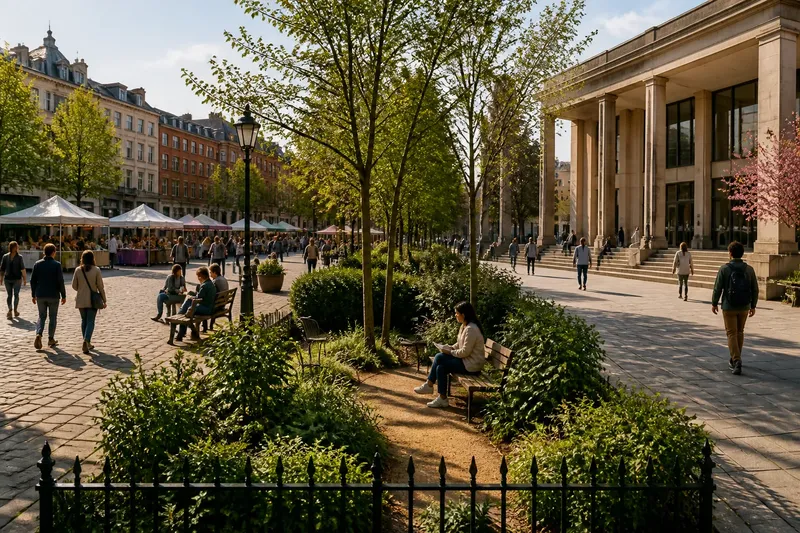
You step off a narrow street into a square, pass a broad paved forecourt and notice a pocket park behind a low hedge. If you are choosing between a square, plaza or pocket park for a short stop, their different shapes offer more than scenery: they affect how a place is organised and what kinds of use it can accommodate.
Rather than ranking these spaces by comfort, compare their civic role, relationship to nearby buildings and capacity for different activities. A square can act as a neighbourhood centre, a plaza can give a building or institution an outdoor forecourt, and a pocket park can bring a small green space into a dense urban block. The labels overlap, but the distinctions help explain why each place feels different.
What does each type of space do for a neighbourhood?
A square is usually a recognisable public open space within a town or neighbourhood, often framed by streets and buildings. Its position and centrality can make it a natural setting for meeting, trading, public events or simply crossing between destinations. Paving, trees and planting may all contribute to its character.
A plaza is commonly a broad, hard-surfaced space associated with a building or civic destination, such as a library, station or office. It can provide an outdoor forecourt, a setting for public activity or a route between entrances. The name does not tell you whether the place is lively or quiet; its relationship to the building and surrounding streets is more revealing.
A pocket park is a compact green space fitted into a neighbourhood, perhaps between buildings or within a leftover street corner. Planting and trees give it a different material character from a largely paved plaza. Its small footprint can make it feel like a local amenity rather than a civic centre or entrance forecourt.
These categories are not rigid. A square might include a garden, a plaza might have substantial planting, and a pocket park could sit beside a busy public building. Think of the terms as descriptions of emphasis, not rules about what a space must contain.
How do their shapes support different kinds of activity?
A square’s open centre and multiple edges can accommodate uses that change over the day. The space may be crossed on the way elsewhere, occupied by tables or stalls, or used for a gathering. Its buildings and street connections often make it part of the neighbourhood’s shared address.
A plaza’s layout tends to be shaped by its adjoining building or institution. A forecourt can make an entrance legible and provide room for people to assemble before or after visiting. Depending on its design, it may also function as a route through the site, so its open appearance does not necessarily mean that all of it is intended for lingering.
A pocket park gives priority to greenery within a limited urban footprint. Its planting can create a small contrast with nearby streets and hard surfaces, while a path or seating area makes the space usable without turning it into a larger civic setting. Because the site is compact, a gathering or play area may occupy much of what is available.
Imagine a neighbourhood block with a market square, a library forecourt and a planted gap between apartment buildings. If a weekend craft stall needs room for several tables and visitors to circulate, the square is the most plausible fit; if the library wants an outdoor setting linked to its entrance, the forecourt fits that role; if residents need a nearby green place to sit among plants, the pocket park addresses a different need. The point is not that one form is superior, but that each makes certain uses easier to accommodate.
What can the edges tell you about a space?
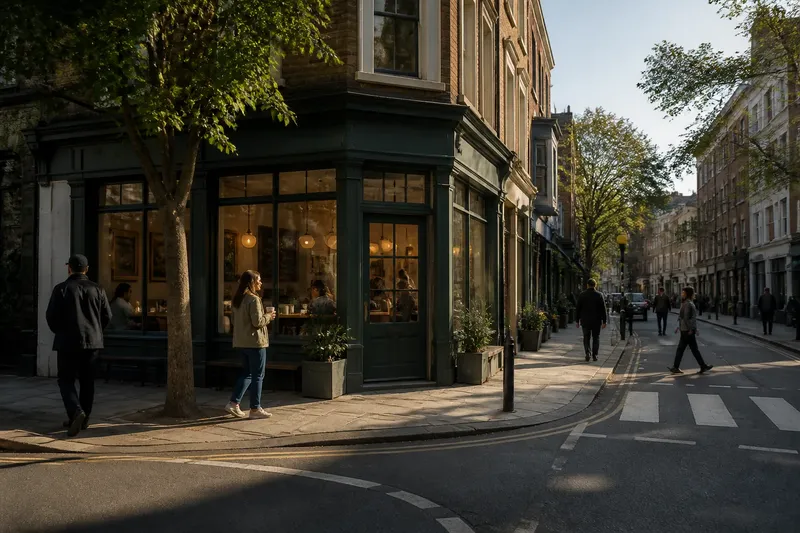
Buildings, walls, trees and changes in paving define where a public space begins and how it relates to its surroundings. A square edged by shops and homes may feel closely connected to everyday neighbourhood life. A plaza framed by a large institution can feel more formal, while the boundary of a pocket park may be marked by a hedge, fence or planted strip.
Edges also shape how people read a place. Shopfronts can make a square’s perimeter active; a broad institutional façade can give a plaza a strong focal point; planting can soften the boundary of a pocket park. These are tendencies rather than promises: blank walls or closed frontages can leave any space feeling detached from nearby activity.
Consider the edge as the rim of a cup: it gives the space a recognisable form, but does not determine what belongs inside. Openings, paths and entrances connect the space to its surroundings; barriers or uninviting boundaries can make those connections feel less direct.
How can you compare a square, plaza or pocket park?
Which type is most likely to host a public event?
A square may suit an event that needs room to gather and links to neighbourhood streets. A plaza can also host public activity, particularly when it is designed as part of a civic or institutional setting. The actual layout, permissions and planned uses matter more than the label.
Does a pocket park have to be entirely green?
No. A pocket park may combine planting with paths, seats or paved areas. Its defining quality is its compact scale and contribution of greenery to the local setting, not the absence of hard surfaces.
Is a plaza private because it sits beside a building?
Not necessarily. Some plazas are public spaces, while access and permitted uses depend on ownership and local arrangements. Check signs or ask the relevant managing organisation if you need to know whether a particular activity is allowed.
Can a square include a garden or planted area?
Yes. A square can contain trees, lawns or planted beds alongside paved areas and routes. Those features add a green element without changing the space’s broader role as a neighbourhood or civic open space.
What should you observe before deciding how a space is used?
- Building relationship: Check whether the space sits in a neighbourhood centre or directly serves a particular building. If it is framed by several streets and frontages, consider its role as a shared square; if it leads to one institution’s entrance, consider it as a forecourt; if neither fits, compare the other features before deciding.
- Open area: Observe whether the centre is mostly clear or divided by planting and paths. If it provides room for a gathering or temporary activity, it may support square-like civic uses; if its available space is limited, consider smaller-scale uses instead.
- Planting: Check whether trees and planted beds are central to the space or occupy only a small part. If greenery shapes the identity of a compact site, it may function as a pocket park; if not, describe the planting as one feature of a square or plaza.
- Entrances and routes: Notice whether paths connect several streets or lead primarily to one building. If connections serve the wider block, the space may have a neighbourhood role; if routes concentrate on an entrance, read it in relation to that destination.
- Frontages: Observe whether doors, windows or shopfronts face the space. If nearby buildings open onto it, its edges may support everyday public activity; if they present mostly blank walls, account for that separation when describing its character.
- Visible use: Check for stalls, gathering, play, crossing or quiet occupation. If one use dominates, describe the space in terms of that observed activity; if uses vary, avoid reducing it to a single purpose.
These observations help distinguish a space’s design intention from what people actually do there. A sign, boundary or local notice can also clarify access and permitted activities when the arrangement is not obvious.
How do you use the distinction between these spaces?
Start with the role you are trying to understand: a neighbourhood gathering place, a building’s outdoor forecourt or a compact green amenity. Then look at the surrounding buildings, the shape of the open area and the way planting and paths are arranged. Those details often offer a clearer description than the name alone.
For a square, plaza or pocket park, the useful comparison is how its form relates to the wider block and the activities it can support. A square can gather a neighbourhood around a shared centre, a plaza can connect public space to an institution, and a pocket park can make room for greenery within a tight urban fabric. Reading those roles closely makes the differences easier to see on an ordinary walk.